As you may have read, we’ve been staying with a friend in Bethesda for a few weeks before we leave DC and move to Oak Park, just outside Chicago. The area we’re staying in is really hilly, so most of my runs, even the easy ones, have been challenging. For my weekend long runs, I’ve been heading to the Capital Crescent Trail, but speed work has been a little trickier. I’ve been warming up until I find a reasonably flat stretch of road and then using that for my intervals, so not really ideal.
Last week, though, I decided to take a look at Google Maps to see whether there were any running tracks nearby that I could use. Amazingly, there’s one just 1.5 miles away at the local high school. After a bit of research online, I discovered that the track is open to local residents outside school hours and when organised practices aren’t taking place, so on my workout day, I laced up my shoes, headed out of the door, and decided to give it a try.
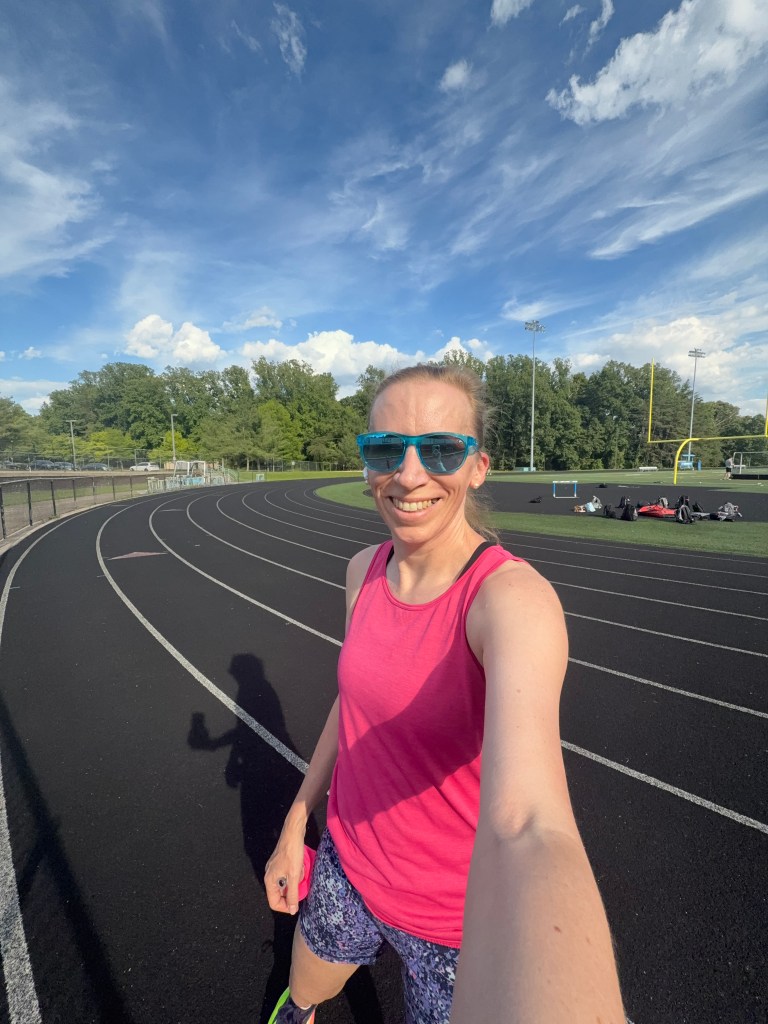
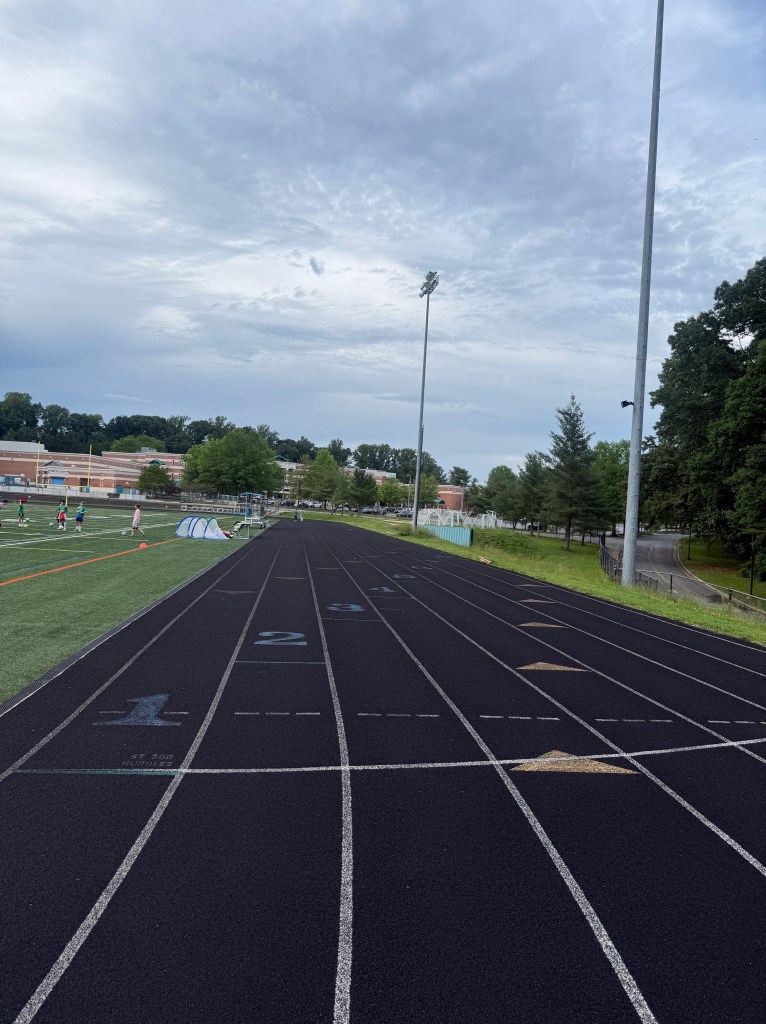
I aimed to arrive at the track at around 6pm, figuring the students would be finished for the day. Luckily, that paid off. There were a few children playing soccer in the middle of the field, a handful of parents spectating, and a couple of teenagers running laps, but apart from that, it was pretty quiet.
When I first ran on a track back in my thirties in Chicago, I found it quite intimidating. Everyone seemed to know exactly what they were doing, and I was convinced I’d accidentally break some unwritten rule and get yelled at. If you’re feeling that way too, know that you’re not alone.
The good news is that running tracks are generally very friendly places and they are for everyone. As long as you’re not interrupting an organised practice or using a facility that’s clearly closed to the public, you’re usually welcome to be there. Tracks also aren’t reserved for elite athletes. They’re for anyone who wants a safe, measured place to run. Whether you’re training for a marathon, working towards your first 5K, or simply trying something new, you have every right to be there.
Here are a few simple track etiquette rules that will help you feel more confident.
Running Track Etiquette for Beginners
- Run anti-clockwise unless signs say otherwise. Most tracks operate in a counter-clockwise direction. If you’re unsure, follow what everyone else is doing.
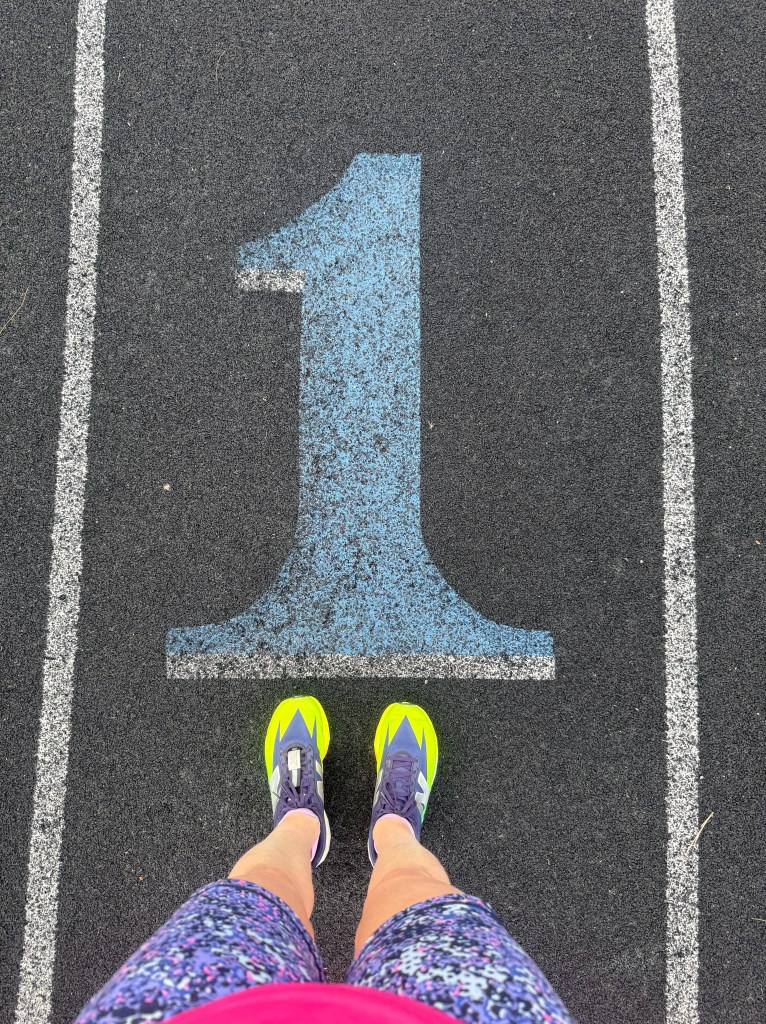
- Use the inside lanes for faster running. Lane 1 is the shortest route around the track and is typically used by runners doing workouts. If you’re walking, jogging slowly, or taking recoveries, move to one of the outer lanes.
- Don’t stop suddenly in Lane 1. If you need to catch your breath, check your surroundings and move to an outer lane or off the track before stopping.
- Look before changing lanes. Just like changing lanes when driving, have a quick glance over your shoulder before moving across the track.
- Pass on the outside whenever possible. If someone is running more slowly than you, simply move out and around them. There’s no need to sprint past aggressively while checking your watch..
- Be aware of organised groups. If a club, school team, or coached session is taking place, give them plenty of space and follow any instructions from coaches or facility staff. I always check in with them to make sure that I won’t be in their way and I’ve found them super accommodating.
- Don’t block lanes while chatting. Tracks are social places, but if you’re stopping to talk to a friend, step off the running surface.
- Leave headphones at a sensible volume. You don’t need to run without music, but it’s helpful to remain aware of other runners around you. I usually run with one headphone and the volume down low so that I can be aware of other people around me.
- Respect any posted rules. Some tracks restrict access during school hours or have lane closures for maintenance. A quick look at the signs when you arrive can save a lot of confusion.
- Remember that everyone was new once. Most runners are focused on their own workout, not judging yours. You belong there just as much as anyone else. I used to think that everyone was watching me, but actually they are so focused on their own workouts that they aren’t paying any attention.
And just in case you don’t know:
How Far Is One Lap?
- 1 lap = 400m
- 2 laps = 800m
- 4 laps = 1 mile (approximately 1600m)
- 6 laps = 2400m
- 8 laps = 3200m
How do you time a lap?
One of the things that used to confuse me about track running was how people knew whether they were running the right pace. The good news is that it’s much easier than it used to be.
Most GPS watches have a lap button. When you start an interval, press the lap button as you cross the start line. When you complete the lap and reach the same point again, press it a second time. Your watch will tell you exactly how long the lap took.
For example, if you’re planing to run 400 metres in 2 minutes, you simply start your watch at the beginning of the lap and stop the lap when you return to the same point. If your watch reads 1:58, you were slightly quicker than planned. If it reads 2:03, you were slightly slower.
Many runners also programme their workouts directly into their watches, which means the watch will automatically time the intervals and recovery periods for them. I love to do this as I am so bad at keeping count of my repeats. Having it stored in my watch is one less thing for my brain to think about when I’m running around in circles like a hamster on a wheel!
When I first started running on a track, I checked my watch constantly. These days, I tend to glance at it only occasionally and run more by feel. The track is actually a great place to learn what different efforts feel like because the distance is always accurate and there are no traffic lights, crossings, or hills to interrupt you.
After just one visit last week, I remembered why I enjoy track workouts so much. The surface is easy on my legs, the distance is accurate, and there’s something oddly satisfying about focusing on nothing but running.
If you’ve been curious about trying your local track but have felt nervous about it, I’d encourage you to give it a go. You might be surprised by how welcoming it feels once you get there. Don’t forget to take fuel/hydration with you, and if it’s chilly, an extra shirt to wear home.
A few final safety tips
Before I finish, there are a couple of practical safety tips worth mentioning.
- Let someone know where you’re going, especially if you’re heading to a track for the first time or running early in the morning or after dark.
- Pay attention to your surroundings. Even on a track, it’s easy to become distracted by music, intervals, or staring at your watch.
- Check that the facility is actually open to the public. Not all school tracks allow community use, and some have specific hours.
- Be mindful of weather conditions. Tracks offer very little shade, so hot summer workouts can feel much harder than expected. Take water/electrolytes if needed.
- Wear lights or reflective gear if you’re running in low light. Tracks are often less well lit than roads and paths.
Trust your instincts. If a track feels deserted, poorly maintained, badly lit, someone seems to be hanging out with no purpose, or otherwise just doesn’t feel right, it’s okay to leave and find somewhere else to run.
Did I miss anything? Any tips you’d like to add?


Leave a Reply