If you’ve spent any time around runners lately, you’ve probably heard people talking about super shoes. These high-tech racing shoes, typically built with ultra-light foams and carbon plates, are designed to help runners go faster and run more efficiently.
Over the last few years they’ve completely changed the racing landscape. In fact, at the Chicago Marathon in 2025, around 70% of men and 57% of women wore super shoes, both sharply up from the year before. Nike held the largest share at 27.4%, followed by ASICS at 17%, Adidas at 15%, New Balance at 8.6%, Brooks at 7.9%, and all other brands combined at just over 20%.
The single most popular shoe? The Nike Alphafly 3, worn by about 16% of all finishers.
So yes, super shoes have very much become the norm in road racing. But the big question is: should you wear them?
The short answer is…probably, if performance matters to you. If you’re chasing a personal best or simply want to run as efficiently as possible on race day, it’s worth trying a pair. Many runners now also use super trainers, shoes with similar foam technology (sometimes with a nylon rather than carbon plate) that are designed to be a bit more durable for workouts and faster training runs (I run in the Brooks Hyperion Max 3).
That said, super shoes aren’t essential. If you’re happy running for enjoyment, community, or finishing goals, the cost of super shoes may not be worth it. I’ve run all my marathons in regular running shoes, and they have been totally fine! It’s also worth remembering that not every runner gets the same benefit from them. Many of the performance gains from super shoes come from the carbon plate acting like a spring when compressed. To get the most out of this effect, runners generally need to be moving at a relatively quick pace (roughly faster than about 8–9 minutes per mile) and landing closer to the mid-foot. Slower runners can still benefit from the softer, more protective foam, but the plate itself may not contribute as much propulsion.
A Quick Word of Caution
Super shoes can feel amazing the first time you try them on. They are so bouncy and tend to pitch you slightly forward and encourage a more upright running posture. Some runners even feel as though they’re being tipped forward onto their toes. This design encourages a stride more similar to elite runners; upright, bouncy and landing closer to the midfoot. But here’s the thing: most recreational runners don’t naturally run that way. Because of this, switching to super shoes can subtly change your running mechanics. That means the stress from running may shift to slightly different muscles or tendons. It’s not uncommon for runners to feel great during the run but notice new soreness afterwards, or worst case, develop an injury.
My advice? Build up gradually.
Don’t go straight from zero to racing a marathon in them. Start with shorter runs, then workouts, and let your body adapt before racing longer distances.
How I Chose Which Shoes to Try
As you can imagine, there are now a lot of super shoes on the market. Between running websites, reviews, podcasts and runner forums, I went down a bit of a rabbit hole reading about them all.
When narrowing down my shortlist, in addition to the features I was looking for in a shoe, I was also thinking about the companies behind them. I try, where possible, to support brands that feel broadly aligned with my values. For that reason, Nike wasn’t on my list, largely because of concerns that have been raised in the past about how female athletes have been treated by the company. I just couldn’t run in a pair of Alphflys! With so many amazing options now available from other brands, it felt easy to explore alternatives.
Knowing what I personally like (and don’t like) in a running shoe helped narrow things down fairly quickly. I prefer a shoe that feels stable, isn’t overly aggressive through the toe-off, and has enough room in the toe box for my foot shape. After a lot of research, I managed to get my list down to three pairs.
Rather than trying them on in a shop, I ordered all three online and tried them at home. I like to support local running stores, but I sometimes find them a bit stressful and at home there is less pressure. You can take your time walking around in them, and you can compare them side by side without feeling that the salesperson wants to hurry and make a sale. I know I missed out on the benefit of expert advice in a speciality running store, but I also felt that I’m experienced enough to figure it out at home.
Below are the three shoes I tried.
ASICS Metaspeed Edge
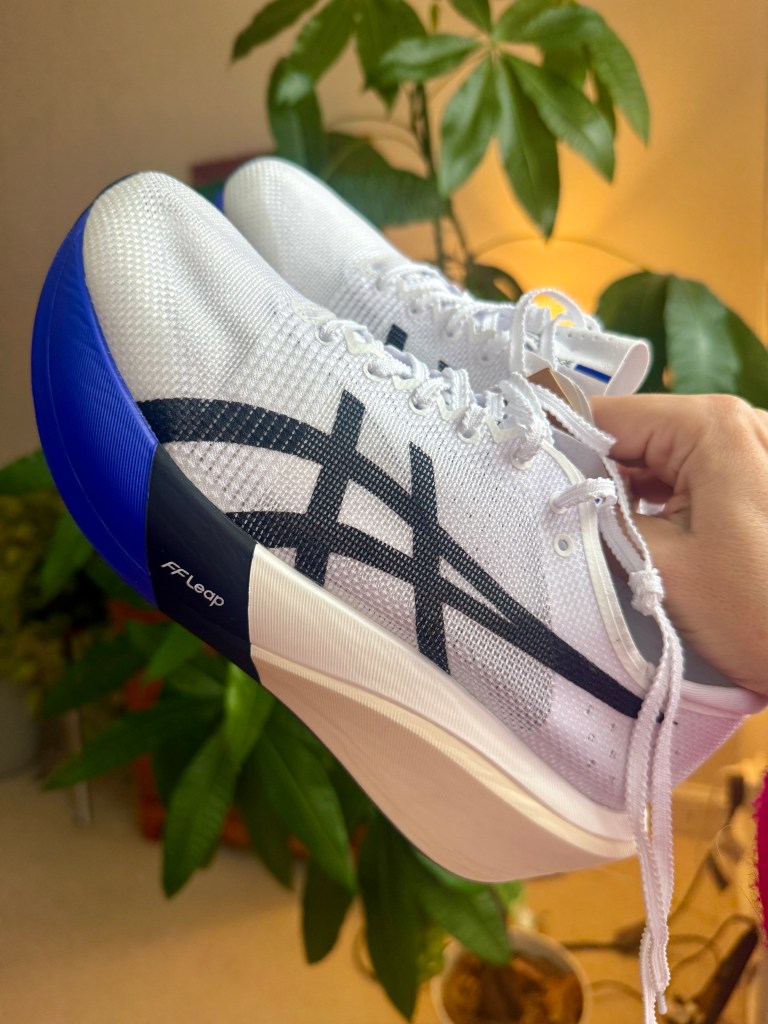
One of the first pairs I tried was the ASICS Metaspeed Edge. I’ll admit, these immediately caught my eye. They look fast. I loved the colours and the overall design, and the heel in particular looked really sleek. I know I need to buy shoes that fit well, but like everyone else, I also like them to be visually appealing!
When I first put them on, they actually felt very comfortable. The midsole foam (ASICS uses their lightweight FF Turbo foam) is incredibly springy and the whole shoe feels very light which is exactly what you want in a race shoe.
However, after walking around in them for a bit, I realised the toe box was just a little too narrow for me. I think if I had sized up, the shoe probably would have been too long overall. It’s possible the upper mesh would stretch slightly over time, but for such an expensive shoe I didn’t really want to take that risk.The other thing I considered was how I run later in a marathon. When I get tired towards the end of a race, I have a tendency to land a bit further back on my foot and heel strike more than I do earlier in the race. The Metaspeed Edge has quite a narrow base and is really designed for runners who maintain a quick cadence and midfoot strike. For someone with that running style, I think these would be a fantastic shoe, but for me, I wasn’t quite convinced they’d still feel stable in the last 6–8 miles of a marathon, when fatigue really starts to set in.
Saucony Endorphin Pro
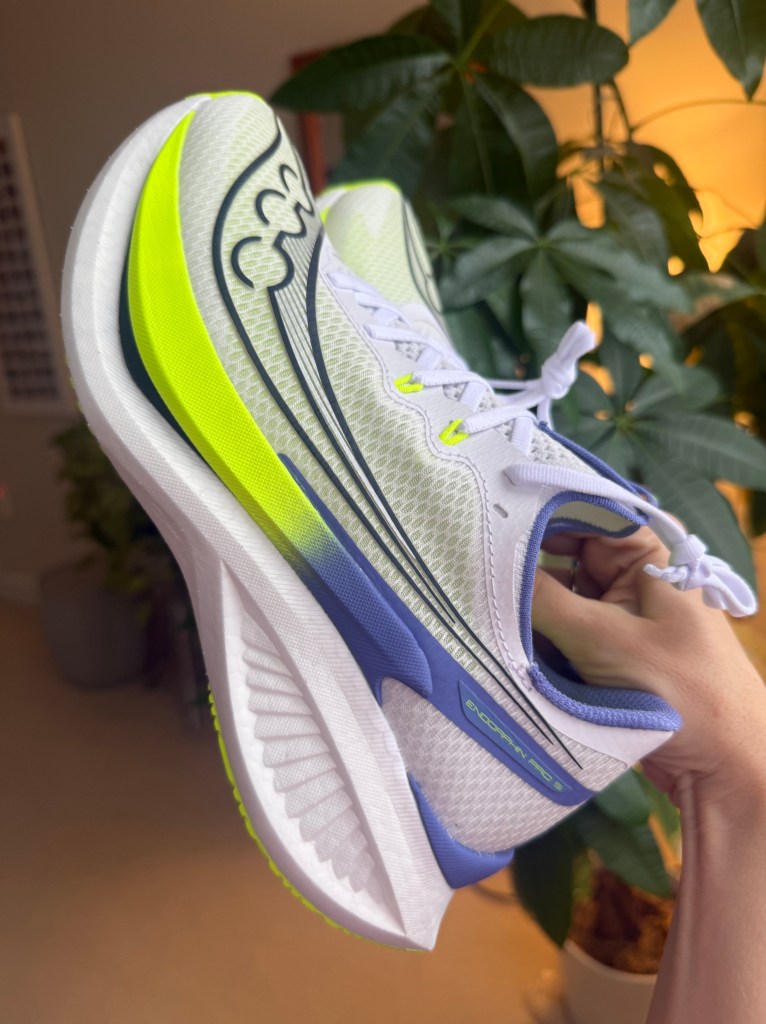
Next up was the Saucony Endorphin Pro. I’ve actually been a big fan of Saucony shoes for years. I first ran in the Kinvaras, which I still enjoy because they’re so flexible and have a very natural feel. I’m sure my feet are stronger from having to work a bit harder when running in them! I’ve also run quite a bit in the Endorphin Speed line, which I think is a brilliant training shoe, especially for tempo runs and speed work, so I was excited to try these.
The Endorphin Pro uses Saucony’s PWRRUN PB foam and a carbon plate, combined with their SpeedRoll geometry, which creates a very pronounced forward roll designed to help you move quickly through your stride. And you can definitely feel that!
The problem for me was the fit through the front of the shoe. Like the ASICS, it felt a bit too narrow in the toe box. I could tell almost immediately that after long miles my toes would start rubbing and blisters would probably follow. The other thing I noticed was how rigid and aggressive the shoe felt. Some runners absolutely love that propulsive sensation, but for me it felt a little too forceful. The heel also concerned me slightly. The back of the shoe is quite high and made with fairly rigid material. Even wearing ankle socks, I had a feeling my Achilles would end up getting rubbed quite badly during longer runs. Given that marathon training involves a lot of miles, that was enough for me to rule them out.
New Balance FuelCell SuperComp Elite v5
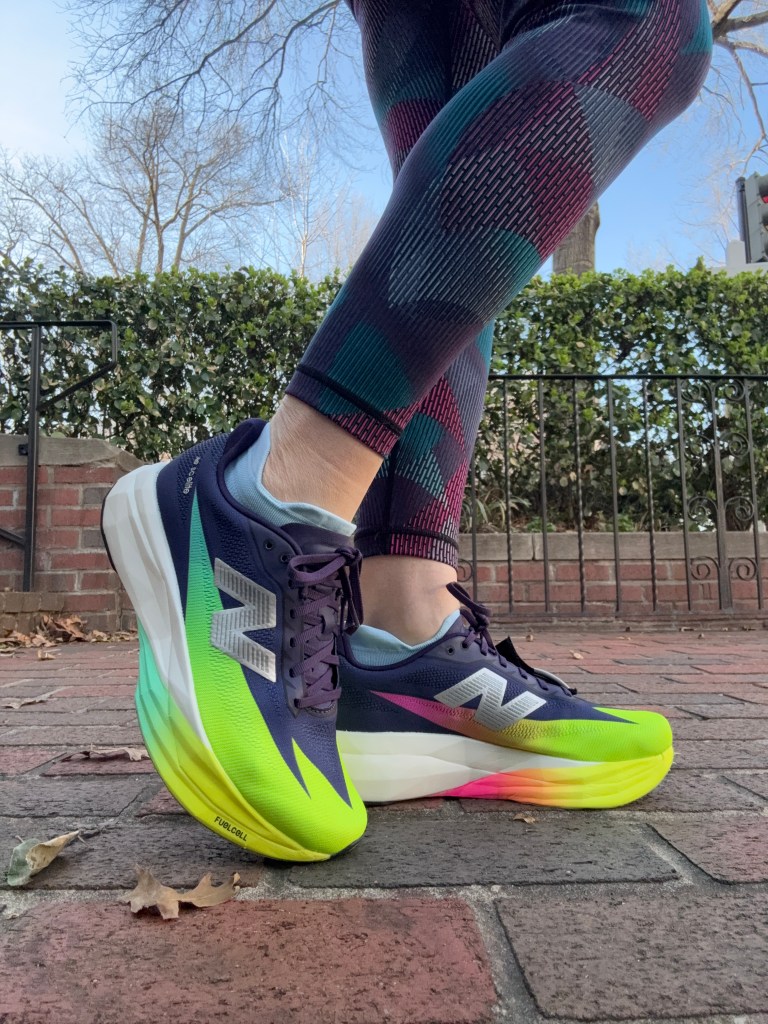
The third shoe I tried was the New Balance FuelCell SuperComp Elite v5, and interestingly it felt quite different from the other two straight away. In some ways it actually felt less “super shoe” than the others, and for me, that turned out to be a good thing, especially as I don’t make a habit of running in super shoes.
The first thing I noticed was how comfortable and soft they felt. New Balance uses their FuelCell foam combined with a carbon plate, which gives the shoe a really lively, bouncy feel underfoot without being overly rigid. Unlike some of the other carbon-plated shoes, there isn’t an extremely aggressive rocker at the front. The toe-off felt much smoother and more natural for my stride.
Another big positive was the stability. The base of the shoe felt a little wider than the ASICS, which gave me more confidence that it would still feel secure when I got tired later in a race.
Finally, the heel area was noticeably softer and more cushioned. The padding around the back of the shoe felt comfortable rather than rigid, which made me much less worried about Achilles irritation during longer runs. Overall, these felt like the best balance of comfort, bounce and stability for the way I run.
The Pair I Chose
In the end, I decided to go with the New Balance FuelCell SuperComp Elite v5. I’ve never run in New Balance before, so I’m looking forward to getting to know them.
As soon as I put them on my feet, a few things stood out. First, they’re really comfortable. Some super shoes feel quite aggressive or rigid, but these felt surprisingly natural the moment I put them on. Having shoes feel comfortable as soon as you slip them on is always a very good sign.
Second, they don’t have an overly aggressive rocker. Some carbon shoes create a very pronounced “tipping forward” sensation through the toe-off, which doesn’t always suit my stride and can change my gait a bit too much. The SuperComp Elite felt smoother and more controlled.
Finally, and this was a big one for me, the toe box shape worked well for my feet. Many racing shoes taper quite sharply towards the front, but this one had just a bit more space, which made it feel much more comfortable. I can see myself running fast race-pace miles in them during workouts, as well as using them for my races.
For my upcoming races this year, including the Shamrock Shuffle in Chicago, the Cherry Blossom 10 miler in DC and the Chicago Marathon they felt like the best balance of speed, comfort and stability. Now the real test begins: seeing how they perform on the road.
What to Look For When Choosing Super Shoes
If you’re thinking about trying a pair of super shoes yourself, it’s worth remembering that not all carbon-plated running shoes feel the same. The right pair for you will depend on your running style, foot shape and the type of races you’re training for. Here are a few things I think are worth paying attention to.
Stability: Super shoes often have very high stacks of soft foam, which can sometimes make them feel a bit unstable, especially on corners or uneven roads. Some models have a wider base or better heel support than others, so if you know you tend to land further back on your foot when you get tired, stability is definitely something to think about.
Toe Box Shape: Many racing shoes taper quite aggressively towards the front to save weight and improve aerodynamics. That works well for some runners, but if you have a slightly wider forefoot (like me) or your feet swell during long runs, a narrow toe box can quickly lead to discomfort or blisters during a marathon.
Rocker and Toe-Off Feel: Most super shoes use a curved “rocker” shape that helps roll your foot forward and create a fast toe-off. Some shoes feel very aggressive and propulsive, while others feel smoother and more natural. Neither is necessarily better, it simply depends on what works best with your stride.
Comfort Over Long Distances: A shoe might feel fast when you jog around your living room or test it for five minutes in a shop, but the real question is how it will feel after 15–20 miles of running. If something already feels slightly tight or stiff when you first put it on, there’s a good chance it won’t improve once you’re deep into marathon miles.
At the end of the day, the best super shoe for marathon running is the one that helps you run efficiently while still feeling comfortable and stable over long distances.
As a reminder for when you’re out shopping:
- stability
- toe box width
- aggressiveness of rocker
- comfort over long distance
Finally…here are some websites that I found really helpful:
https://www.runningshoesguru.com/
https://runrepeat.com/guides/best-super-shoe-running-shoes


Leave a Reply