
We all know that marathons are extremely unpredictable. The weather impacts everything. If it’s hot, humid, rainy, or windy, your time will likely be slower—and rarely is the weather perfect. Then there’s your training to consider, along with any lingering not-quite-an-injury feelings you’ve picked up along the way. Add to that how tired you are, how hectic work has been, or whether you, or your kids, have been sick and anything could happen.
So, all of that aside, I thought I’d write down a few thoughts ahead of the race—partly to see if they come true, and partly to help you figure out your own race goals. It’s easy to justify things after the fact, but I’ve always felt that insight into other people’s training can be helpful and provide a fresh perspective on my own race plans.
In past marathon training cycles, I’ve either worked towards a specific goal or, by the end of the training cycle, been able to reasonably predict a time I think I can hit on race day. But things are a little different this time around. For context: I’m a lot slower than I used to be. When I lived in Chicago, I regularly ran 3:30 marathons. But then came a very annoying and persistent abdominal injury, followed by a pandemic, and I’m nowhere near where I used to be in terms of speed or endurance. I’m also 47, and my body is changing. It’s subtle, but it’s happening, and I’m unsure of the impact that will have on my marathon times.
Last year, I ran the Chicago Marathon with a solid training cycle but no speed-work; I just ran easy miles. I also had a toothache and was taking antibiotics. My goal was to enjoy the run, which I did, and I managed to hit 4:03 in almost perfect weather. I’m curious to see how this year will go. Here are some thoughts on my training:
What’s gone well / What have I done differently this time around?
I’ve been consistent. Since January, I’ve regularly run 25–30 miles per week, so I had a solid base upon which to start my training in June. I hadn’t run as much last year and my base wasn’t as consistent so my ramp up for the marathon was more aggressive than I would’ve liked.
I’ve done a long run of at least 10 miles every weekend since February so I started with a reasonable endurance base.
I’ve raced twice: a 10-miler and an unplanned half in Carmel, so I have a little race practice. Last year I hadn’t run a race for 5 years! It’s really helpful to practice races; remembering what you need to pack, what your morning routine needs to be, and how to pace a race etc..
I’ve joined Orange Theory and added at least one workout per week, which includes a bit of strength and some speed-work, albeit at low-impact.
Since June, I’ve incorporated a weekly tempo run or speed session outdoors. I was nervous about it, as I didn’t want to aggravate my old injury, but I’m glad I gave it a shot. My tempo runs have maxed out at 4 miles, and I’ve also done a few sessions of 800-meter repeats in Rock Creek Park. In general I think these workouts have really helped to make my easy miles feel relaxed, and have improved my efficiency and form.
While my lower abdominal issue still exists, I’ve mostly kept it at bay through weekly strength work, focusing on upper body and core. We have an old Lululemon Studio Mirror in our guest room and I often stream 30 minutes strength classes on it.
My husband and I have cleaned up our diet. While I weigh the same and my body composition hasn’t changed much, I know we’re healthier. We’ve also cut back on alcohol, which has improved my sleep and generally made me feel more alert and clear-headed.
What could’ve gone better / What would I improve for next time?
Running in the heat and humidity of DC has been extremely challenging. My long runs have been such a slog that I’ve had to run by effort rather than pace, so I don’t have many race-pace or faster miles on my legs like I have done in the past.
I haven’t practiced running on flat terrain. All my runs have been on rolling hills or a mix of flat with huge hills at the end. While you might think that’s a good thing, muscles fatigue faster when there’s no variation in the course so I have little idea how this will affect me after 26 miles in Chicago.
Towards the latter end of my training, I did less strength work than I should’ve. I didn’t incorporate much lower-body strength training—most of it was upper body and core. I’d definitely change that next time!
Work has been insane! I’ve spent hours and hours sitting at my computer every day and have been stressed out by huge deadlines, so I haven’t been as relaxed or active overall as I’d like. I’ve been far too sedentary!
This may sound silly, but I haven’t found a pair of running shoes that I love. I usually have a favourite by now, but I’ll be racing in my Saucony Endorphin Speeds, which I like but don’t love. Sometimes they make my feet numb, and I haven’t figured out why.
I’m a little heavier and a little less lean than I’d like to be. I’m starting to figure this out as I’m sure that it is in part due to my age and changing metabolism. Hopefully over the next few months I’ll be able to change this and increase my lean mass for the next race.
So, what are my goals for Chicago, and how do I think it’s going to go?
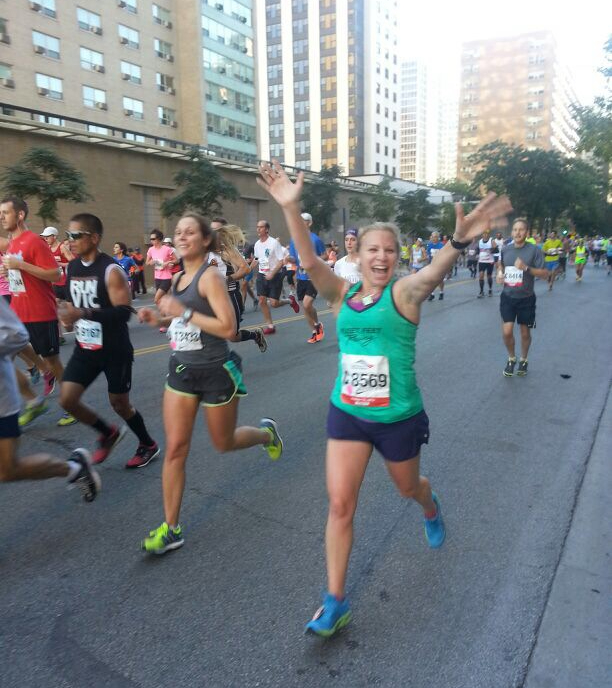
Weather and sickness aside, I’m hoping for a good, solid run. I love running around Chicago, and the marathon is an incredible race, so regardless of my pace, I’m looking forward to the route and finishing strong, surrounded by fellow runners. I’m hoping to run with my friend, Megan (she’s running beside me in the photo below), but we haven’t trained together as she’s in Chicago and I’m in DC, so we need to have a discussion to see whether our race plans align.
I’m in better shape than last year, so I’m hoping to beat my 4:03 time. If the weather cooperates, I think it’s possible, given the extra long runs in DC in the heat, and the weekly speed sessions. On a magnificent day with the wind at my back, I think I could make 3:50. If I could stretch that and match my time from my first marathon at age 34 (3:46:20), that would be amazing! If I had to bet, I’d say I’ll end up somewhere between 3:50 and 4:00, given that I don’t have as much strength as I’d like for the final miles and I think I’ll find the final 10k hard going.
I’ve never put my predictions out into the universe before, but maybe it’ll help someone. I’ve always wished I’d had insight into other people’s training and thought processes – it would’ve been useful for me to have that context, as well as fresh ideas for my own training and race plans. And let’s face it, we all start to go a bit crazy and second-guess ourselves during the taper, so reading about someone else’s plans can reassure us that we’re on the right track and will have a great race day.
Whatever time I end up with, and however race day goes, I will always be grateful for the opportunity to run the Chicago Marathon, and will celebrate all the hard work that got me to the start line. It’s truly a wonderful marathon, exceptionally well organised, celebrated by the whole city, and I love the way that all of the communities come out to cheer the running community over the weekend.
What are your goals for your fall marathon? Have you figured out your race plan yet?
 trainingwithvicky.com
Leave a comment